
Driven by Liquidity, Not Fundamentals

Singapore
Core stance remains unchanged. Market sentiment remains persistently bearish on traditional consumption sectors. Conversely, deep pullbacks in high-quality AI assets offer compelling reaccumulation opportunities.
Here is our updated macro, sector, and crypto market logic:
1. Macro Inflation Risks Remain Contained
June U.S. core CPI is projected to rise by 0.22% month-on-month (3.4% year-on-year), marking a noticeable slowdown from May’s reading. Combined with the upcoming revision to the U.S. core PCE calculation methodology, the overall inflation outlook will remain benign until the release of July inflation data in mid-August, leaving macro inflation risks well contained for the near term.
On the commodity front, geopolitical conflicts in the Middle East are gradually normalizing, following a trajectory similar to the Russia-Ukraine conflict. Following market volatility in March this year, doubts have emerged regarding the authenticity of headline crude oil supply and demand data. For the time being, oil price volatility will be treated as a secondary factor and excluded from core macro market assessments amid cautious observation.
2. Current Market Correction Is Driven by Liquidity, Not Fundamentals
The recent global market pullback is essentially a liquidity-driven adjustment, triggered by deleveraging and Chinese regulatory constraints. After the strong AI rally from April to May, bullish capital sentiment weakened, stirring up widespread market pessimism and narrative-driven fears.
High-growth sector investment has long focused on capturing industry supply-demand gaps. Across industrial cycles, supply expansion follows a predictable and steady pace, while demand fluctuation represents the biggest source of market uncertainty. The resilience of AI end-market demand is fully evidenced by Anthropic’s record-breaking revenue expansion, with explosive ARR growth highlighting robust enterprise demand:
Anthropic Annual Recurring Revenue (ARR) Key Metrics:
• End of 2025: $9B ARR
• May 2026: Surpassing $47B ARR
• Core growth feature: Revenue doubles every six weeks
• Primary drivers: Enterprise API adoption and rapid business scaling
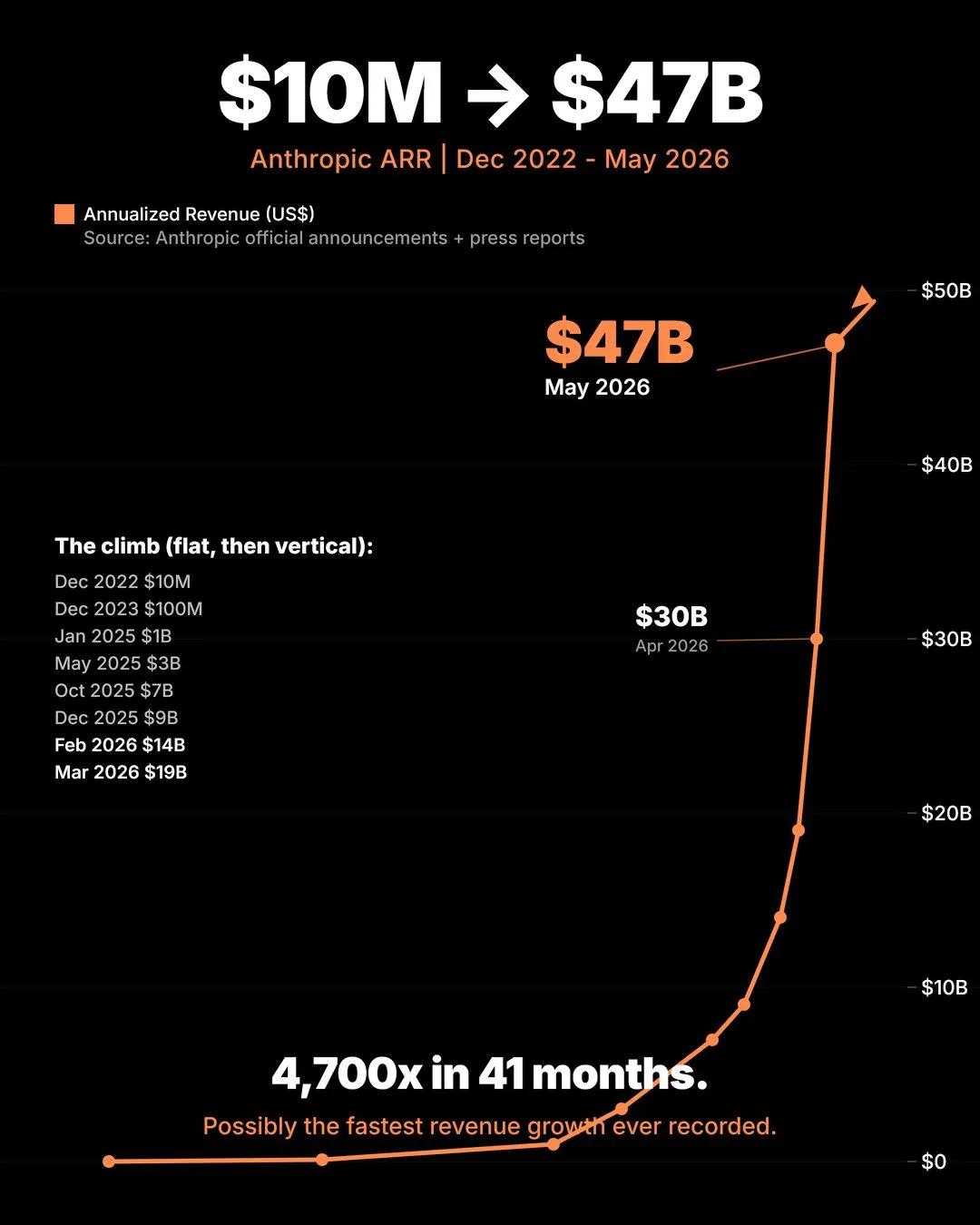
This staggering, multi-fold revenue surge among client-facing AI leaders confirms that the fundamental growth momentum of the AI revolution remains fully intact, decoupled from short-term market sentiment declines.
3. Pros and Cons of Current Market
Compared with the second half of 2024, today’s market features both advantages and disadvantages:
✅ Advantage: The AI industry boasts far clearer and more deterministic long-term growth trends.
⚠️ Disadvantages: Higher overall index levels and increasingly dominant quantitative trading volume, amplifying market volatility.
Current market pressures stem entirely from capital sentiment and liquidity shifts, rather than fundamental deterioration. Market participants are advised to maintain patience amid short-term fluctuations.
4. Convergence of Crypto and Traditional Exchanges Reshapes Market Liquidity
A major structural shift is underway: crypto exchanges are rapidly converging with traditional exchanges. While competing for global trading volume, the two markets have formed a new symbiotic relationship through cross-market liquidity, clearing mechanisms, and arbitrage activities. This trend is completely reshaping crypto market capital flows.
Two core development models are emerging:
1.Traditional Asset Perpetual Contracts on Crypto Platforms
Crypto exchanges have launched perpetual contracts covering stocks, indices, and commodities, with independent pricing, market-making, and clearing systems. Time differences, capital cost gaps, and liquidity inconsistencies between crypto trading sessions and traditional spot markets have created new basis spreads and structural arbitrage opportunities.
2. Crypto Platforms as Traditional Market Trading Gateways
Leading crypto exchanges now act as brokerage portals, directly connecting user orders to mainstream traditional markets including the NYSE and NASDAQ. Users can trade traditional assets via crypto accounts, with full liquidity supported by traditional exchange infrastructure.
This structural change is diverting active capital away from altcoins toward newly launched traditional asset contracts. As a result, liquidity in the altcoin market continues to dry up.
For low-liquidity crypto assets, price movements are now dominated by order book depth rather than fundamental changes, leading to more extreme sharp spikes and sudden dump volatility.
This is not investment advice. Markets are inherently volatile and unpredictable, and investors should always retain humility and respect for price action.