
NFP Surge: Dismiss Noise, Buy Macro Repricing

Singapore
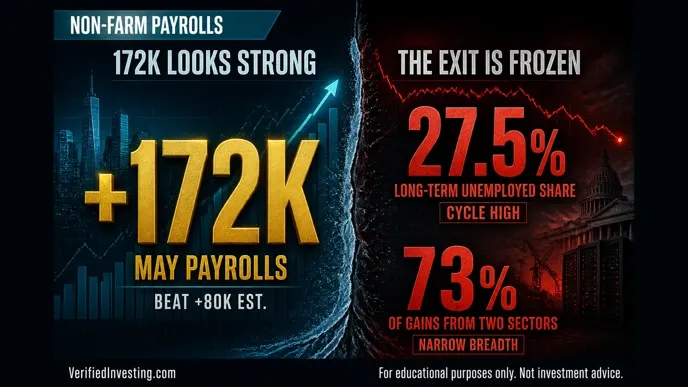
Last Friday (June 5, 2026), the U.S. released May non-farm payrolls at 172,000, nearly double the consensus estimate of 85,000, with March and April figures revised up by a combined 93,000. The robust print triggered violent cross-asset swings: U.S. tech stocks suffered a sharp correction from highs, the Nasdaq 100 tumbling 4.77% for its worst single-day drop since April 2025; liquid assets whipsawed, with Bitcoin briefly slipped into the 50,000s before bouncing back, and gold rallying strongly before fading. Our core view remains unchanged: periods of macro risk repricing present buying opportunities, though market trading forces may prolong the correction. Technology will stay the main investment theme. Going forward, Bitcoin’s next leg higher will rely on tech fundamentals rather than liquidity tailwinds.
1. Filter Out Market Noise & Reassess U.S. Equity Valuations: Avoid Trading Against Quantitative Strategies
We believe last Friday’s tech selloff was an overreaction, not a fundamental breakdown. While the headline 172,000 jobs and upward revisions pushed the 3-month average to 188,000—its highest since May 2024—a granular breakdown reveals significant one-off noise: roughly 70,000 jobs, or 40% of the total, came from leisure and hospitality, tied to pre-World Cup hiring for the June 11 tournament. These are temporary, event-driven roles, not signs of persistent labor-market overheating.
The Nasdaq’s ~4.8% plunge was a reasonable response to rising rate-hike expectations (markets priced a 57.7% chance of a 2026 hike, up from 41.6% pre-print), but the extra 2–3% loss reflected a violent unwind of crowded tech/AI trades. When industry trends remain intact, sentiment-driven deleveraging creates entry points.
Current rate-hike fears stem from both data and hawkish Fed rhetoric (Logan, Hammack). Data-driven worries should ease near term: April core CPI at 0.4% MoM was distorted by rent calculation anomalies; stripping this out, May core CPI should cool. Sustained tech downside is unlikely.
Pre-2022 rate-hike playbooks are obsolete. While monitoring crowding is sensible, relying solely on technical indicators in a quant-dominated market is risky. Retail investors should avoid direct trading against quant funds—they will lose. Instead, focus on what works: deep research into long-term industry trends.
2. Macro Risks in June: Look Beyond Priced-In Headlines
June is packed with macro risks, but well-telegraphed threats (hawkish Fed comments, inflation fears, BOJ hikes) have been largely priced in by media and markets alike. The real danger lies in underappreciated, undiscussed risks.
Take Japan: “Japanification” has faded from headlines, but its shadow lingers. Watch consumption tax cut implementation and fiscal funding needs, not just the high-probability BOJ hike.
In 1998, during Japan’s brutal debt deleveraging, unleveraged buys of Keyence yielded solid returns by 1999; Yamaichi Securities and Hokkaido Takushoku Bank went bust. The Fed does not fight U.S. industrial trends, but it sacrifices non-U.S. emerging markets (and even U.S. growth if needed) for domestic stability.
Post-payroll tech carnage demands rigorous risk-resilience checks on non-U.S. assets. Only two groups survive:
- Export-oriented tech leaders with global pricing power
- Businesses that can deliver capacity in short supply
This is not investment advice. Markets are inherently volatile and unpredictable, and investors should always retain humility and respect for price action.