
A Buying Opportunity, Not an Exit

Singapore
Current markets are in a macro risk digestion phase, which I view as a window for position accumulation rather than exit. The defining feature of this year’s market is not elevated macro risks, but extremely strong trading momentum. The confluence of quantitative strategies, ETF flows, passive allocations and leveraged capital has lengthened correction cycles: adjustments that historically resolved in two weeks are now stretching out over a month. Accordingly, our core market outlook remains unchanged, and we are maintaining a patient approach to market timing.
1. Macro Risks Are Likely Becoming Muted
We continue to expect the Federal Reserve to hold rates steady at its June 18 meeting. Less important than the policy decision itself will be Governor Walsh’s inaugural FOMC speech.
For the past month, market volatility has been driven by two core concerns: interest rate trajectories and inflation persistence. Following the release of nonfarm payroll data, both narratives have been largely priced into markets.
Unless Walsh strikes a surprisingly hawkish tone, the marginal impact of macro variables will continue to fade. Market focus will then shift away from rate volatility and back toward corporate earnings fundamentals.
The same logic applies to Japan. A Bank of Japan rate hike is already fully consensus, yet I doubt it will meaningfully support the yen. Investors across US, Japanese, Korean, Taiwanese and A-share markets face the same core positioning call: prioritize AI exposure and underweight demand-sensitive sectors.
2. Rebound Rotation to Consumer? A Disputable Thesis
A common market question lately is whether investors should rotate from extended tech names into undervalued consumer stocks. Before making such a shift, two questions must be answered: Why has Chinese consumption remained resiliently weak? And have the fundamental headwinds constraining consumption growth been resolved?
Without clear affirmative answers, rotating purely for valuation compression is premature. High-frequency data across auto sales, property transactions and Chinese baijiu end-market demand all confirm feeble fundamental momentum for Chinese consumption. To emphasize: current fundamentals do not support a tactical rotation into domestic consumer plays.
Japan’s economic experience from the 1990s through the 2010s offers a critical template. During its prolonged economic stagnation, the market’s outperformers were globally competitive industrial leaders such as Keyence, FANUC and Tokyo Electron—not domestic-facing firms tethered to local demand. Capital markets never operate on a balanced domestic-external demand split. The decisive divide is always between companies with scalable global competitiveness and those limited to stagnant home markets.
For portfolio defense amid market pullbacks, a modest allocation to high-dividend banking stocks is preferable to chasing consumer sector rebounds.
3. Gold’s Under-the-Radar Performance and Long-Term Value
Gold has remained subdued despite persistent official sector purchases from global central banks. The disconnect stems from a stark divergence between buyers and sellers. Gold ETFs have seen consistent outflows in recent weeks, driven by CTA strategies, macro hedge funds, trend-following capital and late-cycle profit takers. These flows are purely liquidity and momentum-driven short-term trades.
On the buy side, gold’s core institutional supporters are global central banks, sovereign wealth funds and long-term strategic allocators, primarily across China, India, the Middle East and Eastern Europe. These participants are not targeting quarterly trading gains, but executing long-term de-dollarization portfolio diversification.
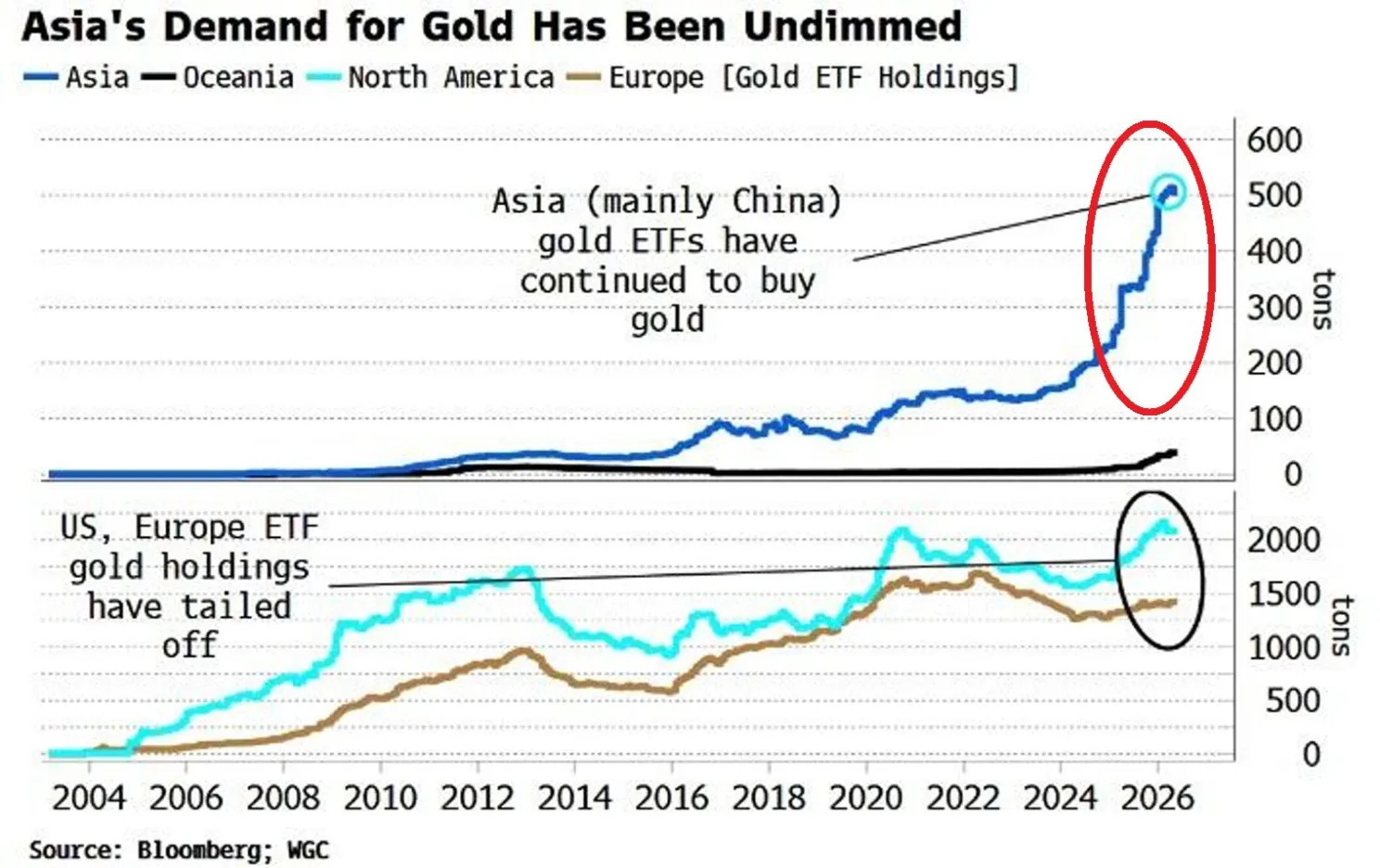
Gold’s recent weakness reflects short-term technical adjustment rather than a breakdown of its long-term bullish thesis. While near-term volatility will persist, we expect gold to retest the 5,000 level later this year.
4. Bitcoin remains even more underappreciated
While gold has fallen out of market focus, Bitcoin remains even more underappreciated, making it one of our highest-conviction tactical ideas right now. BTC is exhibiting price action similar to gold, with even more pronounced valuation suppression amid the ongoing AI market frenzy.
As a non-yielding asset, BTC has long faced structural pressure from higher interest rates. Now that market liquidity concerns have eased meaningfully, this key headwind has diminished. If AI equities face a material pullback with broad institutional profit-taking in July and August, vacated capital will seek alternative exposure. Undervalued gold and BTC will likely re-emerge as preferred allocation targets.
Our positioning strategy is simple: scale into gold gradually and accumulate BTC on dips. A BTC retest of the $50,000 level in the next one to two months would represent an exceptional high-conviction buying opportunity.
The hardest part of investing is not identifying viable opportunities, but maintaining conviction in undercrowded trades.
This is not investment advice. Markets are inherently volatile and unpredictable, and investors should always retain humility and respect for price action.