
Crowded AI and Long-Term Contrarian Plays

Singapore
1. Equity Sector Split – AI Tech Becomes the Only Crowded Long Trade
Bank of America’s latest capital flow data showed global equity funds drew a net inflow of $55.2 billion, hitting a 19-month high. Breaking down regional allocations: US equities attracted $38.37 billion, European stocks $10.66 billion, and Asian equities $3.92 billion.
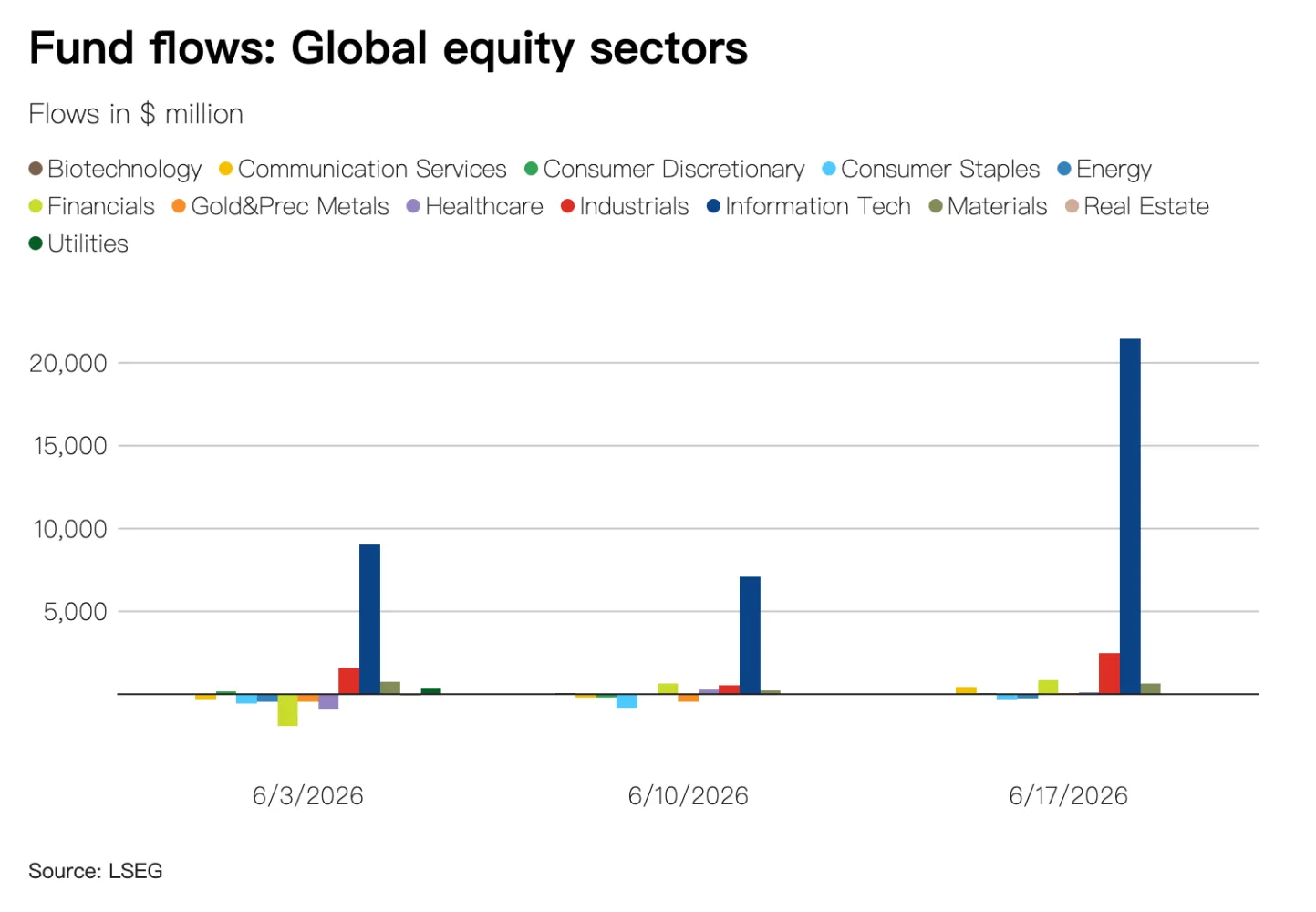
By sector, tech secured a record single-week inflow of $21.46 billion. Global bond funds saw sustained inflows of $17.17 billion, while money market funds took in $40.03 billion.
Contrasting this risk-on sentiment, precious metals and gold funds posted outflows for the fifth consecutive week at $1.78 billion, and emerging market equity funds (including China A-shares) recorded $2.88 billion in redemptions. Separately, JPMorgan’s latest report noted nearly all foreign passive capital inflows into China since September 2024 have exited the market. Broadly, global investors remain concentrated on US tech and artificial intelligence as core allocation themes.
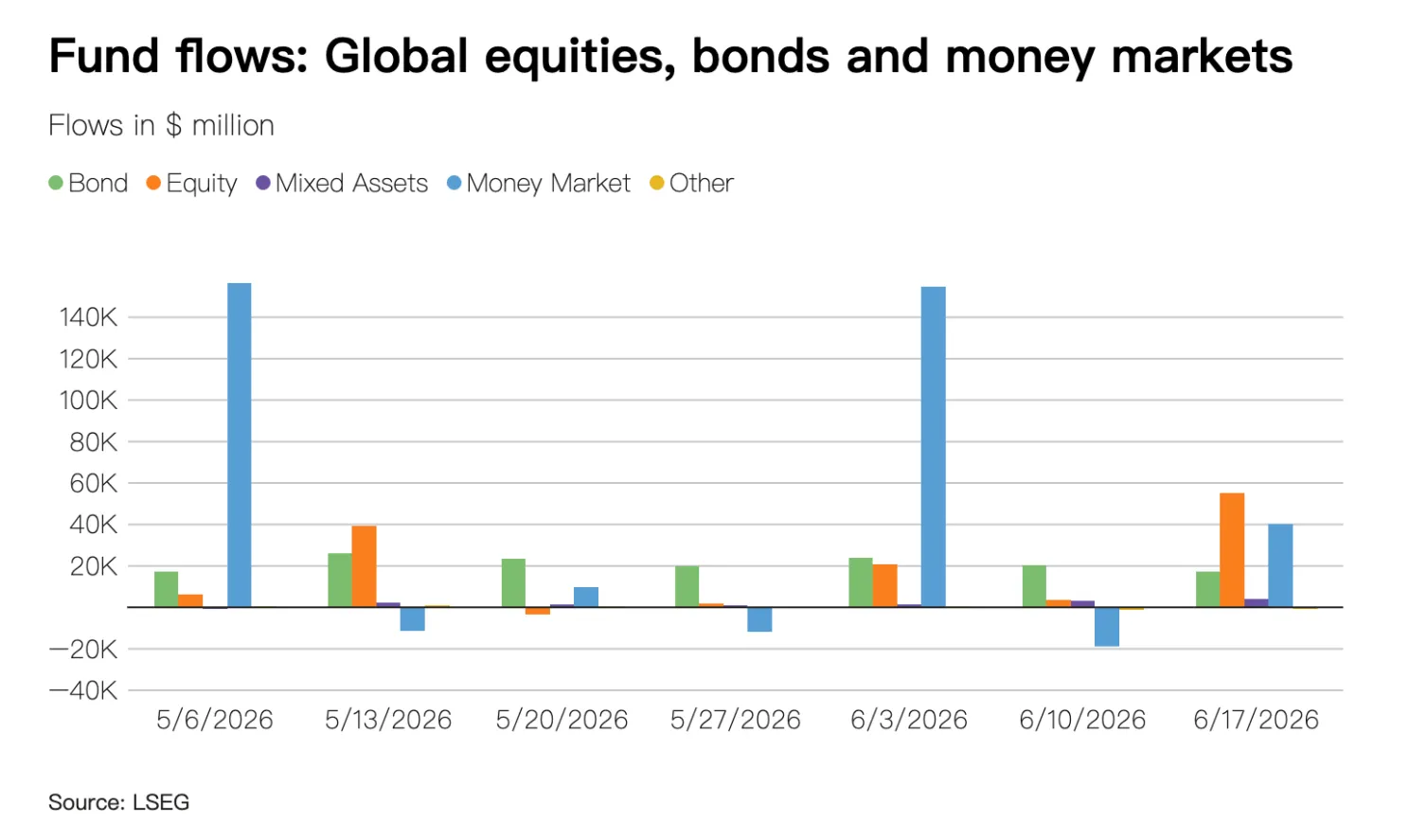
Bank of America flagged AI as one of the world’s most crowded institutional trades. While AI remains a definitive long-term beta play for years to come, the risk-reward profile for chasing further near-term gains has deteriorated amid overconcentrated positioning and uniform bullish consensus. A sharp market pullback triggered by Fed policy shifts, economic prints or corporate earnings in July–August would present an attractive entry point for long-term positioning.
2. Shifting Fed Policy Framework to Boost Market Volatility
Christopher Waller has advocated greater policy opacity and a diminished role for forward guidance, a structural macro shift unlikely to be priced in by markets over the short run. The June 18 FOMC meeting itself carries limited immediate risk, yet Waller’s policy stance merits close monitoring. A downward trajectory in Fed policy predictability is set to lift post-meeting market volatility and dilute the market impact of first-hike or first-cut trades.
This week’s US core PCE and GDP prints (due Thursday) will serve as a key litmus test, with consensus projecting a 0.38% month-on-month rise. A market shrug amid hot data signals investors have not priced in the new Waller-era policy regime; a risk-off reaction would signal persistent volatility driven by incoming economic releases.
The US and Japan stand as the only major economies with drastically lagging monetary policy. Their resilient growth leaves policymakers reliant on a baseline forecast that supply-demand imbalances will normalize. Absent this normalization, both nations will require three or more rate hikes to tame inflation and cap long-dated Treasury yields.
3. Mideast Geopolitics as a Transient Market Headwind
US-Iran tensions will exert only marginal market impact unless crude output or oil supply chains are disrupted. Middle Eastern geopolitical flare-ups act as short-term noise rather than long-term drivers of asset prices. Markets have fully priced in Iran-related oil supply risks over recent months, highlighting how real-world dynamics outpace rigid traditional macroeconomic models.
Foundational assumptions underpinning classic supply-demand frameworks are being upended by AI advancement, energy supply restructuring and global supply chain reshuffling. Conventional economic cycle and terminal valuation frameworks offer limited actionable insight for practitioners amid ongoing industrial transformation, even if core economic theories hold true over ultra-long horizons.
4. Long-Term Beta Investing: Buy the Dip on High-Growth Core Assets
This week, we partnered with the Wealth Management Institute (WMI) under Singapore’s MAS for a roundtable with 35 family office principals, featuring valuable insights from Liang Xinjun.
Liang argued transformative investment opportunities emerge from short-term drawdowns within secular growth trends, rather than chasing fleeting market fads. Bitcoin exemplifies this thesis: despite multiple corrections exceeding 50% over the past decade, long-term holders have generated outsized returns versus most asset classes. Twelve-year historical data shows BTC logged positive annual performance in most years, with multi-year deep bear markets being rare—these peak-pessimism phases represent optimal accumulation windows for long-duration capital.
Successful investing hinges less on timing market tops and bottoms, and more on identifying secular beta assets and deploying capital contrarianly amid broad market fear. For multi-decade allocation, the critical research question is not when to sell, but which assets can be held for a full decade.
This is not investment advice. Markets are inherently volatile and unpredictable, and investors should always retain humility and respect for price action.